
We are fully licensed across the UK, Ireland, Switzerland, Germany and the USA, enabling us to support customers with compliant cross-border talent acquisition.


From startups to global tech giants, our Dublin office provides tailored recruitment services to Ireland's burgeoning Deep Tech sector.
WeWork Bankside, Charlemont Exchange, Charlemont St, Saint Kevin's, Dublin, D02 VN88






















SALARY GUIDE
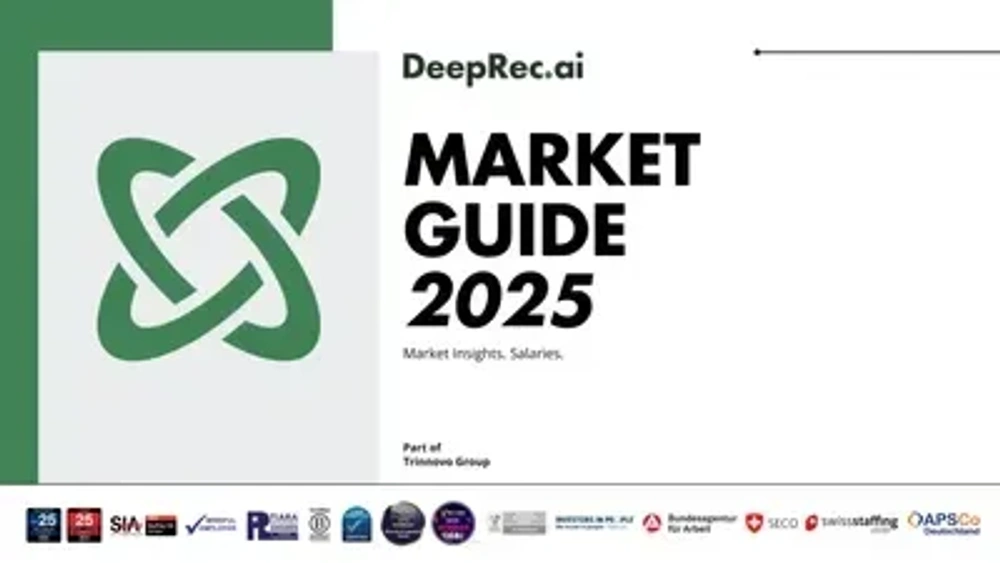
Built with fresh insights from our talent network, we developed this guide for anyone hoping to benchmark salaries, align remuneration with the wider market, or learn more about the trends and opportunities across the German Deep Tech space. Download your copy here:
INSIGHTS

Physics AI Is Well Funded. Finding the Engineers Is the Hard Part
 Ed Killin
21 days ago
Building AI Teams at Startup Speed: Scaling Specialist Talent Across Switzerland and the US
 Anthony Kelly
about 1 month ago
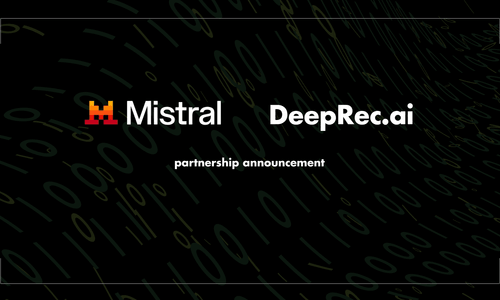
DeepRec.ai partners with Mistral to support the growth of its Applied AI team
 Hayley Killengrey
2 months ago
Scaling AI Teams: A Guide to High-Volume Hiring
Hayley Killengrey3 months ago
LATEST JOBS
Berlin, Germany
Senior Perception Engineer – Radar
Permanent
Senior Perception Engineer – Radar
Location: Berlin, Germany
Shape the radar capability behind real-world Level 4 autonomous driving.
DeepRec is partnering with a German autonomous driving company that has developed its own Level 4 system, with vehicles already driving autonomously on Berlin’s roads. The team is now expanding its perception capabilities to support increasingly robust performance in complex driving conditions.
We’re looking for a Senior Perception Engineer to take ownership of radar within a team with established camera and LiDAR expertise. You’ll influence how radar is used, which approaches are developed and how it contributes to the wider perception architecture.
The role
You’ll take radar beyond its current object-level fusion role, developing capabilities that make fuller use of raw radar data, detections and point clouds. A key ambition is to build towards learning-based camera–radar fusion and strengthen perception in conditions where other sensors can struggle.
This is a hands-on senior engineering position with substantial technical influence. You’ll combine deep radar expertise with the flexibility to contribute across perception, explaining technical trade-offs and helping stakeholders make informed investment decisions.
What you’ll do
Define and develop radar’s contribution to the perception stack, working closely with camera and LiDAR engineers.
Build and improve algorithms using raw radar data, detections and point clouds.
Own radar calibration work and investigate sensor alignment and performance issues.
Develop classical perception pipelines, including rule-based detection, clustering and occupancy grids.
Help architect and implement camera–radar fusion, including learning-based approaches.
Evaluate radar performance across driving scenarios and challenging environmental conditions.
Translate experimental findings into clear recommendations on algorithms, hardware and development priorities.
Contribute to broader perception challenges as the team and platform evolve.
What you’ll bring
Typically five to six years of relevant experience in perception, with substantial hands-on radar development.
Experience working below object-list level with raw radar data, detections and point clouds.
Practical radar calibration experience.
Strong knowledge of classical perception methods, including detection, clustering and occupancy representations.
A broader understanding of perception systems and how complementary sensors contribute to reliable scene interpretation.
The ability to take an algorithm from investigation through implementation and evaluation.
Clear communication and the confidence to advocate for technical decisions using evidence.
Adaptability and a willingness to contribute beyond your specialist area.
Useful additional experience
Automotive radar, ADAS or autonomous driving development.
Experience with multiple radar hardware types.
Camera–radar fusion and learning-based perception.
Modern C++, particularly C++17 or C++20.
Evaluating perception algorithms on real vehicles.
A PhD is not required; practical engineering depth and ownership matter most.
Why join?
You’ll become the team’s key radar expert, with the opportunity to shape a capability that is still at an early stage within an operational autonomous driving system. Your work will influence both the immediate perception pipeline and the longer-term sensor fusion architecture.
 Paddy Hobson
San Francisco, United States
Member of Technical Staff, Security
Permanent
About Us
Sieve is a multi-modal lab curating the world's highest-quality training datasets, spanning video, audio, images, text, and 3D. We combine exabyte-scale data infrastructure and novel multimodal understanding techniques that push the frontier of foundation models. Video alone makes up 80% of internet traffic, and across modalities, data has become the enabling medium powering creativity, communication, gaming, AR/VR, and robotics. Sieve exists to solve the biggest bottleneck in the growth of these applications: high-quality training data.
We partner with top AI labs and did $XXM last quarter alone, as a team of ~30 people. We also raised our Series A from Tier 1 firms such as Matrix Partners, Swift Ventures, Y Combinator, and AI Grant.
Why Now
Frontier technology: Help protect the data that supports advances in AI, from generative media to robotics.
Research and engineering: Work alongside teams building data collection systems, distributed infrastructure, and tools for AI research and customer delivery.
Velocity and ownership: Shape the security roadmap, influence architecture, and carry improvements from design through production as our systems evolve.
Strong team culture: Collaborate directly with a close-knit team focused on helping AI understand and interact with the world.
About the Role
As a Security Engineer at Sieve, you will serve as the technical and strategic owner of our security program. Your mission is to protect the data, infrastructure, and applications that help AI understand and interact with the world. Every control you build supports the trust of our contributors, partners, and customers.
Sieve builds training data for AI across video, audio, images, and robotics. Our work spans real-world data collection, large-scale processing, and customer delivery across cloud infrastructure, applications, and recording devices. You will secure this full lifecycle, including sensitive recordings, untrusted uploads, and access across customer and partner organizations.
This is a hands-on role with ownership of both strategy and implementation. We are looking for a security engineer with a builder's mindset who wants to set the standard for protecting the data behind frontier AI.
What You'll Do
Secure systems at scale: Partner with product, infrastructure, and research teams to design, implement, and improve secure systems at scale.
Detection and response: Build and operate detection and response capabilities.
Incident command: Serve as incident commander for high-severity security incidents, coordinating investigation, containment, and remediation.
Hands-on engineering: Write code, strengthen security foundations, and help engineering teams build and release software securely.
Requirements
Significant security experience
8+ years of progressive experience in security engineering, including technical ownership of security initiatives in production
Demonstrated expertise in cloud security across GCP, AWS, or Oracle Cloud, and container security with Docker and Kubernetes
Hands-on experience building and operating detection and response pipelines and handling incidents from investigation through recovery
Deep understanding of networking, authentication, authorization, encryption, and identity-based access for people, services, and automation
Familiarity with SOC 2, ISO 27001, and privacy requirements, with the ability to translate them into technical controls
Strong programming skills in Python, Go, or a comparable language, with experience automating security controls and securing software delivery
Technical leadership
Ability to design network isolation, cloud permissions, and customer access boundaries that enforce least privilege across infrastructure and applications
Proven ability to define a security roadmap that balances research and engineering speed, customer commitments, compliance, and business risk
Track record producing clear security metrics, audit evidence, and risk updates that help leadership make informed decisions
Collaboration and mindset
Clear verbal and written communication, with the ability to explain security risks and tradeoffs to technical and nontechnical audiences
Comfortable partnering with product, infrastructure, research, data operations, and legal teams to embed security throughout the stack
Ability to lead cross-functional initiatives and mentor engineers through design reviews, practical guidance, and hands-on implementation
Thrives amid rapid change and ambiguity, where sound technical judgment and practical risk reduction matter more than checklists
In person at our SF HQ
Bonus
Hands-on experience in hardware security for recording devices and embedded systems, including device authentication, encryption key protection, secure firmware updates, and physical tampering defenses
Benefits
401k + Full Health Insurance
Breakfast, Lunch, and Dinner covered and your choice of snacks
Ubers covered home
All roles at Sieve require you to be onsite in San Francisco 5 days per week.
 Luke Weekes
Barcelona, Spain
Senior LLM Research Engineer
Permanent
Senior LLM Research Engineer - Training, Post-Training & Model Efficiency
We are recruiting for a well-funded deep-tech company developing more efficient and capable AI models.
Joining its Research team, you will work directly on large language and multimodal models, taking experiments from initial ideas through training, evaluation and efficient inference. The work spans distributed training, reinforcement learning, model compression and distillation, with opportunities to contribute to research papers, open-source code and model releases.
This role suits someone who enjoys working inside models: understanding training behaviour, changing implementations, debugging difficult problems and building evidence through rigorous experiments.
The role
Depending on your strengths and research priorities, you will:
Train and post-train language and multimodal models on multi-node GPU clusters, using supervised fine-tuning, preference optimisation, reinforcement learning and distillation.
Develop and evaluate compression techniques, including quantisation, pruning and low-rank methods, alongside recovery training to preserve model capabilities.
Build reward functions, verifiers and training environments for reasoning, coding and agentic tasks.
Investigate alternative and hybrid architectures, including state-space models, linear attention and mixture-of-experts.
Develop data pipelines for curation, filtering, deduplication and synthetic data generation.
Design reproducible experiments and evaluations covering reasoning, coding, long-context performance and instruction following.
Profile and improve inference performance across GPUs and other accelerators, assessing latency, memory use and throughput.
Share findings, review code and mentor colleagues.
What you will bring
At least four years of hands-on experience training or post-training transformer models.
Strong PyTorch skills, including experience modifying model implementations, custom losses and training configurations.
Experience running distributed training across multiple nodes using frameworks such as FSDP, DeepSpeed or Megatron-LM.
Practical understanding of parallelism strategies and cluster environments using Slurm or Kubernetes.
Hands-on experience with supervised fine-tuning, DPO and at least one reinforcement-learning method, such as PPO or GRPO.
Strong foundations in linear algebra, optimisation, probability and training dynamics.
An understanding of GPU memory, mixed precision, profiling and performance bottlenecks.
Rigorous experimental practice, including ablations, reproducibility, experiment tracking and careful evaluation.
A Master’s or PhD in a relevant subject, or equivalent industry experience.
Strong debugging and communication skills, with fluent English.
Additional experience we would welcome
You do not need experience in every area. Depth in some of the following would be valuable:
LLM post-training frameworks such as TRL, verl, OpenRLHF or NVIDIA NeMo.
Quantisation-aware training, pruning, distillation or other model-compression techniques.
RL rollout infrastructure, reward modelling, verifiers and agentic environments.
Multimodal training, world models or vision-language-action models.
State-space models, linear attention or other emerging architectures.
Inference optimisation, CUDA or Triton kernels, and deployment on alternative accelerators or edge devices.
Research publications, substantial open-source contributions or publicly released models.
 Nathan Wills
Berlin, Germany
Physical AI Researcher - Physical AI
Permanent
Physical AI Researcher
Berlin, Germany | Full-time
You want your research to do more than produce another conference paper. Here, you'll work on making Foundation Models, including Vision-Language Models (VLMs) and Vision-Language-Action Models (VLAs), run in real time on actual devices and robots. You'll join an expanding European research team working at the intersection of Efficient AI and Physical AI, turning research into technology used in real-world products.
You'll research and develop new approaches to robot learning and model optimisation, from fine-tuning VLA policies and exploring World Models to quantisation, pruning and efficient inference. You'll also validate your work on real hardware, profiling latency and memory across GPUs, NPUs and robots. Your research will contribute directly to NetsPresso, an on-device ML framework that brings optimised AI models into customer products.
This is an opportunity to take ownership of research from identifying problems and developing new methods through to benchmarking, publication and deployment. You'll collaborate with research, framework and embedded engineering teams in Europe, alongside wider R&D teams in Korea. As an early member of the European team, you'll have real influence over the research direction.
You'll need a PhD or equivalent research experience, strong Python and PyTorch skills, and experience in at least one of model optimisation or Foundation Model training and fine-tuning. Experience with VLMs, VLAs, robot learning, on-device deployment or tools such as TensorRT and CUDA would be a real advantage. Publications at leading AI or robotics conferences are also valued.
If you want to work on emerging AI research that makes its way out of the lab and onto real devices and robots, let's have a conversation.
You'll need:
PhD or equivalent research experience in a relevant field.
Experience in model optimisation or Foundation Model development.
Strong Python and PyTorch skills.
Ability to independently research, reproduce and validate published methods.
Interest in taking research through to real-world deployment.
 Harry Brant
Atlanta, United States
Chief Technology Officer
Permanent
Chief Technology Officer, Autonomous Vehicles
Location: Remote, North America (US or Canada), with regular travel to operational sites
Employment Type: Full time, permanent
Compensation: Top-of-market base salary plus a significant equity package
About the Company
Our client is a fast-growing autonomous vehicle company deploying driverless technology in commercial operations. Unlike many in the space, they are already live, with a fleet of autonomous vehicles doing real work every day for a major enterprise customer.
The company is well funded following a recent growth round, is generating revenue, and is scaling its fleet significantly across multiple customer sites. It operates in a structured, well-defined environment, which makes fully driverless operation a concrete, near-term milestone rather than a long-term ambition.
The Role
This is the most senior technical position in the company. As Chief Technology Officer, you will lead the full technical organization of 60 to 70 people across autonomy, hardware and engineering, reporting to the founders.
Your primary goal in the first year is to lead the company to its first iteration of driverless operations. You will set the technical direction, build and lead a world-class engineering organization, and represent the company’s technology to investors, partners and the wider industry.
The role will grow with the business through its next stages of funding and scale.
What You Will Do
Own the technical vision, roadmap and architecture for reaching fully driverless operations
Lead and scale the engineering organization across autonomy, hardware and software
Make clear, decisive technical calls that move the team forward quickly
Build a strong leadership team and attract top engineering talent
Drive a culture of safety, systems rigor and fast, accountable execution
Represent the company’s technology with investors, partners and at industry events
Shape the technical organization as the company scales through future funding rounds
What We Are Looking For
Director level or above at an autonomous driving company (robotaxi, autonomous trucking or similar)
Direct experience on the autonomy stack itself, having seen autonomy taken from early development into live production at scale
A track record of building, growing and leading high-performing engineering teams
Strong independent technical judgment and the confidence to make decisive calls
Comfort working at startup pace, with real timelines and high ownership
A strong network and the ability to attract top-tier engineering talent
Specialists from one area of the stack (such as perception, planning or localization) will be considered if they bring Director-level leadership and exposure across the wider stack. Distinguished Engineers from autonomy are also welcome to apply.
Nice to Have
Experience with safety-critical systems and functional safety (e.g. ISO 26262, SOTIF)
Experience presenting to investors or boards, or speaking at industry events
Why Join
The top technical seat at a commercially deployed, revenue-generating autonomy company
A clear, achievable path to driverless operations in a structured environment
Well funded after a recent growth round, with the fleet scaling significantly
Highly flexible compensation, with a top-of-market base and a significant equity stake
Fully remote across North America
A fast, founder-led interview process
 William Osborn
San Francisco, United States
Robotics Researcher - World models
Permanent
Robotics Researcher, World-Action Models (first robotics research hire)
San Francisco, on-site 5 days a week. Up to around $300k base plus equity.
The company: A Series A multimodal data lab of about 30 people, backed by Tier 1 investors and already generating strong revenue from top AI labs. It curates video, egocentric, tactile and 3D training data, and is moving from generative AI into physical AI.
The role: Train and evaluate world-action models and 3D perception systems to show which data actually improves robot capabilities. You own projects from question to answer, report to the CTO, and set the research direction as the first hire in this area.
What you will do
Train and post-train action-conditioned world models and policies (manipulation, commanded actions, camera motion).
Run data ablations across egocentric human video, teleop and robot rollouts.
Build 3D labelling pipelines from raw video: depth, camera trajectories, hand/body/object pose, point tracks, reconstruction.
Design held-out evaluations and benchmarks; use simulation where it makes them cheaper.
Turn findings into curation and capture specs, and publish papers, datasets and benchmarks.
What you need
4+ years in robot learning, embodied AI or 3D computer vision. PhD welcome, not required.
Have trained a policy or world model (VLA, diffusion policy, imitation learning, action-conditioned video model) and tested it on unseen data.
Hands-on 3D vision: multi-view geometry, depth, pose, tracking or reconstruction.
Fluent Python with PyTorch or JAX; rigorous with baselines and ablations.
Clear communicator.
Nice to have: learning from egocentric or human video and retargeting to robots; policies deployed on real hardware; MuJoCo or Isaac Sim; large-scale distributed training; early-stage startup experience.
 Harry Crick
Virginia, United States
Senior ML Engineer, Localization
Permanent
Senior Machine Learning Engineer – Localization
Autonomous Vehicles | Remote (US or Canada)
$187,000 – $250,000 base + bonus + equity
About the company
Our client is a well-funded autonomous driving company building Level 4 self-driving technology. It has strong long-term backing and is moving toward commercial deployment, so the models built now will run in real-world operation.
About the team
You’ll join the localization team, which builds the ML models, state estimation algorithms and production software that tell the vehicle exactly where it is and how it’s moving, in real time. The team fuses data from cameras, LiDAR, radar and other sensors, and works closely with perception, mapping, planning and controls.
What you’ll do
Design, train and deploy production ML models for learned localization, odometry, pose estimation, sensor calibration and map matching
Build scalable training and evaluation pipelines in PyTorch on large real-world datasets
Improve state estimation and multi-sensor fusion algorithms
Analyze large-scale data to find failure modes and drive improvements
Write production code in Python and C++
Own features end to end and lead design discussions
What we’re looking for
Hands-on experience developing your own ML models for localization problems, including architecture, training, loss functions and experimentation
Experience with learned localization, odometry, pose or state estimation, calibration or map matching
Strong PyTorch and Python skills
A solid grounding in 3D geometry, coordinate transforms and probabilistic estimation
Experience taking models into production
An MS with 3+ years of relevant experience, a PhD with 1+ year, or equivalent
Nice to have
Traditional localization experience such as SLAM, visual odometry, factor graphs or Kalman filtering, alongside modern ML
C++
Distributed training, real-time deployment or uncertainty-aware ML
Backgrounds welcome
Automotive, robotics, aerospace, drones, industrial robotics and mobile localization are all welcome. Strong PhDs with applied research are encouraged to apply.
Why join
Build the core localization models for a Level 4 system heading into commercial deployment
Develop your own models, not off-the-shelf solutions
Work with large-scale real-world sensor data
Fully remote, with visa sponsorship available
William OsbornBerlin, Germany
Devops Engineer
Permanent
Senior DevOps Engineer (m/f/d) – Hybrid Infrastructure
Location: Berlin, Germany | Employment: Full-time
Start: As soon as possible
Build the infrastructure behind real-world autonomous driving.
DeepRec is partnering with a German autonomous driving company developing a full Level 4 system for European roads. Combining perception, explainable AI, decision-making and vehicle control, the team is building technology designed to make autonomous mobility safe, understandable and ready for certification.
We’re looking for a Senior DevOps Engineer to develop and operate the hybrid infrastructure supporting its engineering teams, vehicle test data and technical monitoring systems.
The role
You’ll work across on-premises and cloud environments, taking ownership of Kubernetes infrastructure, automation and observability while helping developers resolve practical problems.
A major focus will be preparing the technical monitoring system for 24/7 operation. You’ll also help manage and filter data from vehicle testing and training activities, making it available for analysis and model development.
This is initially a hands-on individual contributor role, with the potential to move into team leadership as the function grows. Participation in a future on-call rota will be part of the role.
What you’ll do
Build, maintain and improve hybrid infrastructure spanning on-premises systems and cloud providers.
Manage Kubernetes environments, including AWS EKS, and support reliable containerised workloads.
Automate infrastructure provisioning and configuration using Terraform and Ansible, alongside improvements to CI/CD pipelines.
Support developers with deployment, infrastructure and environment issues, turning recurring problems into lasting improvements.
Develop monitoring, logging, metrics and tracing to give engineering teams clear visibility into system health and failures.
Prepare the technical monitoring platform for continuous operation, including alerting, troubleshooting and operational readiness.
Manage data lake infrastructure and workflows for ingesting, processing and filtering vehicle test and training data.
Evaluate cloud, NeoCloud and GPU-as-a-Service providers against workload requirements, reliability and cost.
Support secure access management and reliable communication between services.
What you’ll bring
At least six years of relevant experience across DevOps, systems administration, cloud infrastructure or platform engineering.
Strong hands-on Kubernetes experience, including AWS EKS.
Experience operating hybrid environments and understanding the networking and operational challenges between on-premises and cloud systems.
Practical knowledge of Terraform, Ansible and infrastructure automation.
Experience with AWS, Docker and CI/CD workflows.
Hands-on monitoring and alerting experience using Grafana and Prometheus.
Strong systems troubleshooting skills and a sound understanding of TCP/IP networking.
A collaborative approach to supporting developers, balancing immediate fixes with longer-term platform improvements.
A structured working style, curiosity about new technologies and a willingness to learn from experimentation.
Professional working proficiency in English; German is a plus.
Willingness to participate in on-call support as the platform moves towards 24/7 operation.
A background progressing from systems administration into DevOps would be particularly relevant.
Useful additional experience
Kafka for event handling and data streaming.
Data lakes and workflows for large volumes of test or training data.
Keycloak or Active Directory for identity and access management.
Envoy or service mesh technologies for service communication and observability.
OpenTelemetry and the Grafana LGTM stack: Loki, Grafana, Tempo and Mimir.
NeoCloud providers, GPU-as-a-Service or infrastructure supporting AI workloads.
GitHub and Jira.
Cloud certifications from AWS, Google Cloud, Azure or other relevant providers.
Mentoring engineers or taking on technical leadership responsibilities.
Why join?
You’ll help shape the infrastructure connecting autonomous driving development, vehicle data and operational monitoring. Your work will directly influence how effectively engineers build, test and troubleshoot the technology.
There’s scope to make meaningful platform decisions, explore new infrastructure providers and establish the practices needed for reliable round-the-clock operation. As the team expands, there may also be an opportunity to grow into a leadership position.
Paddy Hobson