
Harry Crick


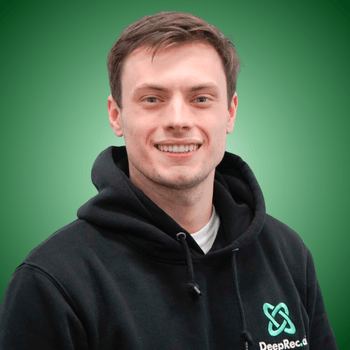
Harry Crick is a Principal Consultant at DeepRec.ai, specialising in video generation, diffusion models, and world models within the US market. He works closely with ambitious startups, VCs, and forward-thinking enterprises to identify and secure elite AI talent that can turn cutting-edge research into production reality.

With a sharp focus on the intersection of computer vision, generative AI, and simulation, Harry helps teams rapidly scale by bringing in the exact specialists they need - from foundational model researchers to applied video and world-model engineers. His clients value his ability to deeply understand both the technical requirements and the strategic importance of these hires.

Before entering the recruitment field, Harry spent four years working as a currency trader, where he managed capital for multiple online property firms and individual investors.

Outside of work, Harry is a passionate follower of space exploration, closely tracking the progress of companies like SpaceX and Blue Origin. He also enjoys playing golf, hosting game nights, and travelling to new countries (Currently on 25+).

Connect with Harry to explore how he can help bring your video generation, world model, or broader generative AI vision to life.
Jobs from Harry Crick

California, United States
Senior CVE - 3D Reconstruction
Senior ML Engineer, 3D Reconstruction Bay Area, California (on-site) | $190k–$260k base + RSUs | Relocation and visa support You've shipped Gaussian splatting or NeRF into something people actually use, and you'd rather see your reconstructions running in a product than sitting in a paper. This team needs exactly that. What the team does This team turns real-world driving data into photorealistic, controllable simulation. Autonomy teams at major automotive and trucking companies use it to train and test self-driving systems before they reach the road. The team works like a startup inside a large, well-funded business: it owns its revenue, engineers sit in on customer demos, and priorities move with what customers need. You get startup-sized scope without wondering whether the next funding round will close. What you'll work on You'll take learning-based reconstruction, mainly 3D Gaussian splatting with some NeRF, and turn it into production software. That means rebuilding large driving scenes with moving vehicles and pedestrians in them, editing those scenes, and rendering new viewpoints for both camera and LiDAR. A big part of the job is speed and scale: making reconstruction faster and higher quality across huge volumes of fleet data, and moving from per-scene optimisation to feed-forward reconstruction so each new scene costs far less to process. You'll also help define how fidelity and the sim-to-real gap get measured, so the team can prove its simulation matches the real world. Around 70% of the work is building production systems and 30% is working with a research group next door. If your work is strong enough, there's room to publish at CVPR or ICCV with them. What you'll need 5+ years developing and shipping ML or computer vision systems Hands-on experience with 3DGS and NeRF, beyond reading the papers A solid grounding in multi-view geometry, camera models and differentiable rendering Python and PyTorch, plus C++ and/or CUDA A track record of turning research into production-quality software Nice to have: feed-forward or generalisable Gaussian splatting; SfM, SLAM or photogrammetry; rendering, rasterisation or ray tracing; multi-sensor data from autonomous vehicles or robotics; papers at CVPR, ICCV, ECCV, NeurIPS or SIGGRAPH; an MS or PhD. You don't need any autonomous-driving background. People from mapping, AR/VR, graphics and 3D content have made the move.
Harry CrickHarry Crick
San Francisco, United States
Robotics Researcher - World models
Robotics Researcher, World-Action Models (first robotics research hire) San Francisco, on-site 5 days a week. Up to around $300k base plus equity. The company: A Series A multimodal data lab of about 30 people, backed by Tier 1 investors and already generating strong revenue from top AI labs. It curates video, egocentric, tactile and 3D training data, and is moving from generative AI into physical AI. The role: Train and evaluate world-action models and 3D perception systems to show which data actually improves robot capabilities. You own projects from question to answer, report to the CTO, and set the research direction as the first hire in this area. What you will do Train and post-train action-conditioned world models and policies (manipulation, commanded actions, camera motion). Run data ablations across egocentric human video, teleop and robot rollouts. Build 3D labelling pipelines from raw video: depth, camera trajectories, hand/body/object pose, point tracks, reconstruction. Design held-out evaluations and benchmarks; use simulation where it makes them cheaper. Turn findings into curation and capture specs, and publish papers, datasets and benchmarks. What you need 4+ years in robot learning, embodied AI or 3D computer vision. PhD welcome, not required. Have trained a policy or world model (VLA, diffusion policy, imitation learning, action-conditioned video model) and tested it on unseen data. Hands-on 3D vision: multi-view geometry, depth, pose, tracking or reconstruction. Fluent Python with PyTorch or JAX; rigorous with baselines and ablations. Clear communicator. Nice to have: learning from egocentric or human video and retargeting to robots; policies deployed on real hardware; MuJoCo or Isaac Sim; large-scale distributed training; early-stage startup experience.
Harry CrickHarry Crick